Cloud Concepts
Definition
- Delivery of computing services over the internet (common IT infrastructure such as virtual machines, storage, databases, and networking).
- Cloud services also expand the traditional IT offerings to include things like Internet of Things (IoT), machine learning (ML), and artificial intelligence (AI).
- It allows to move capital expenditure (servers, datacenters, etc) into operational expenditure (cloud costs).
Benefits
- High availability: Always available (SLA)
- Scalability:
- Vertical: Ease to add more power to machines
- Horizontal: Ease to add more machines
- Reliability: Decentralized, globally distributed
- Predictability: Constant performance and costs
- Security: Different levels of access, built in protection
- Governance: Ease to implement compliance
- Manageability: Ease to add/delete resources and interact with infrastructure
Models
3 different models:
- Public Cloud:
- Build controlled and maintained by a third party
- Available to the public
- Hybrid Cloud:
- Use private and public clouds interconnected
- Private Cloud:
- Cloud used by a single entity
- On premises
- Offers total control
- More cost and complexity
Service Types:
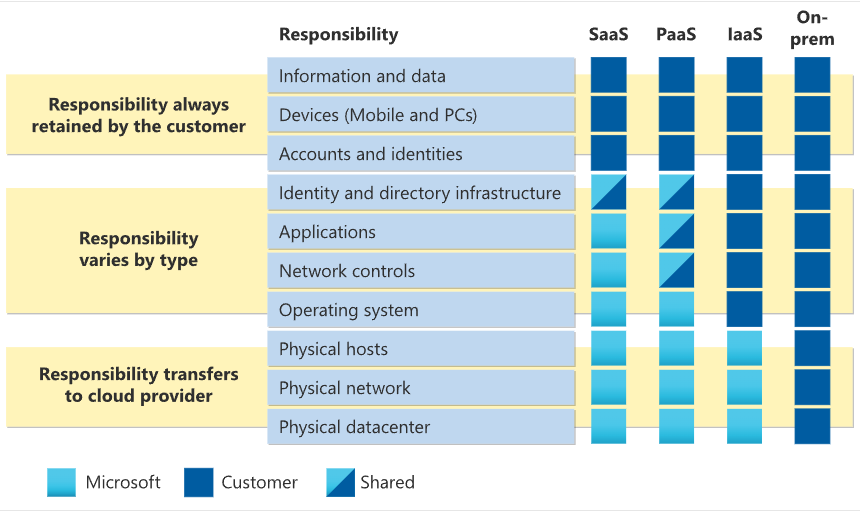
Cloud providers distinguish 3 types of service. Each service place responsibility to the provider or the customer side (Shared responsibility model). These are:
- IaaS:
- Infrastructure as a service
- Most responsibility to the customer
- Provider maintains and manages physical infrastructure
- Examples include VM services, virtual networks, etc.
- PaaS
- Platform as a service
- Middleground
- Provider additionally maintains OS, dev tools, etc.
- Examples like Azure app services, AKS
- SaaS
- Software as a service
- Complete managed solution
- Examples include Managed dbs
The different responsibilities for each service type are shown below